
By Omar Shaban
It is a direct and deliberate policy of slow death, by forcing the population into an extremely small area that effectively becomes a tiny, overcrowded prison cell packed with inmates.
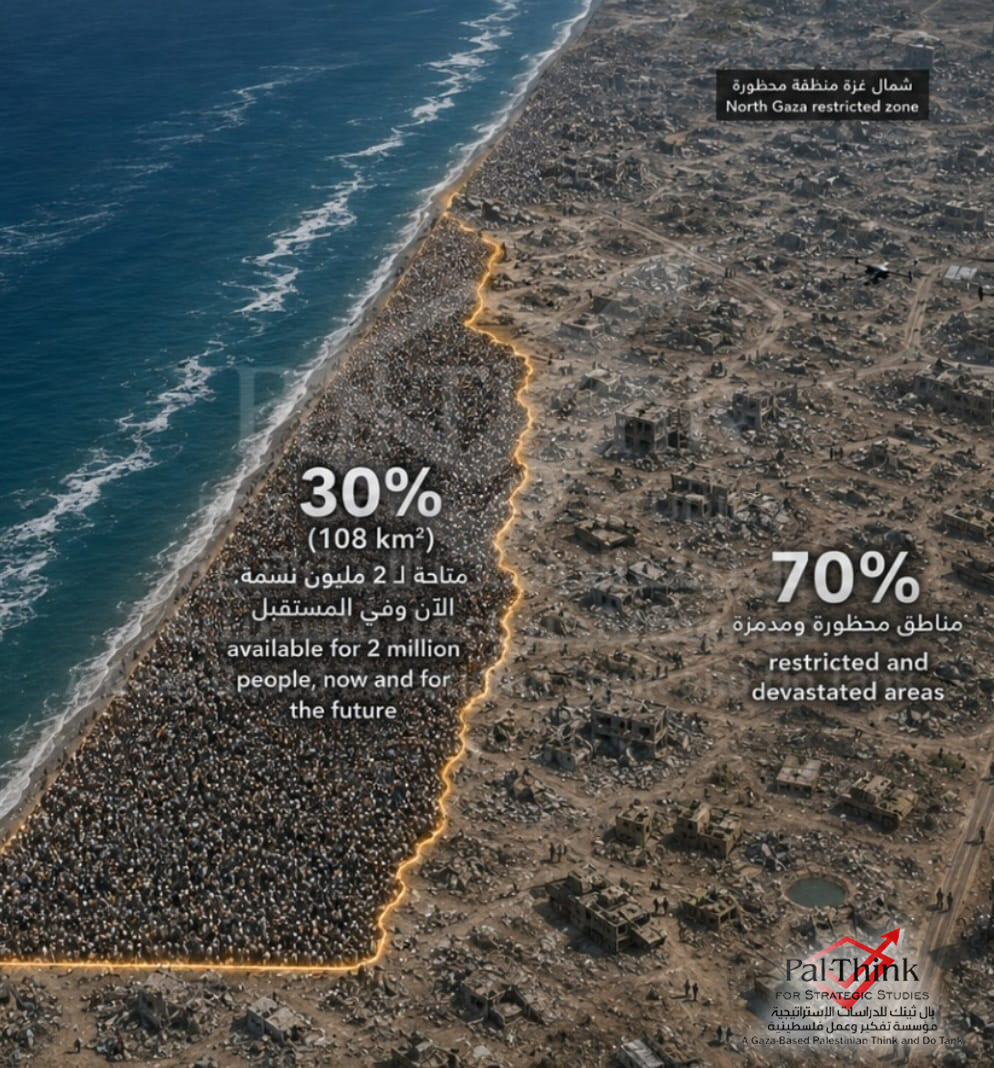
The Gaza Strip’s area is 362 square kilometers and was inhabited by 2.2 million people, making it one of the most densely populated areas in the world, with an average density of around 6,000 people per square kilometer. If the population is squeezed into only 30% of the territory, the density would rise to approximately 18,000 people per square kilometer.
A massive population is being squeezed into an extremely small area without even the minimum standards of public health services, wastewater treatment, healthcare institutions, education, or productive economic activity. This is compounded by the presence of tens of thousands of vulnerable people—especially injured children, people with mobility impairments, elderly women, and thousands of widows who lost their primary breadwinners during the war.
The result is not only severe overcrowding, but also immense pressure on every aspect of daily life: access to medical care, clean water, sanitation, education, housing, employment, and social support. Under such conditions, the most vulnerable groups are often the hardest hit, as they require greater assistance and services at a time when resources and infrastructure are already under extreme strain.
For comparison, population density per one square kilometer is about 90 people in Morocco, 125 in Egypt, 40 in the United States, 150 in China, 290 in the United Kingdom, 500 in India, and 400 in Belgium.
The occupied areas in the Gaza Strip, especially in Beit Hanoun, Beit Lahia, Deir al-Balah, and Rafah, contain much of Gaza’s agricultural land, which serves as the territory’s food basket. These areas also include water wells, desalination projects, and wastewater treatment facilities. They represented Gaza’s main reserve for future expansion.
Gaza’s population growth rate is around 60,000 people per year. Under normal circumstances, the territory would need approximately 60 new schools annually, as well as several hospitals, cemeteries, sports facilities, and other public services. This is in addition to the need to rebuild the hundreds of schools and hospitals and the tens of thousands of homes and factories destroyed during the war.
There would be no available land to build schools, drill water wells, construct greenhouses, establish community facilities, or even create new cemeteries. It is worth remembering that even before the war, many areas of Gaza already faced shortages of land for schools, cemeteries, and other public facilities. Much of the land that has come under occupation—around 70%—is public land, which would normally be used for schools, universities, sports clubs, cemeteries, water infrastructure, sewage systems, solar energy projects, and other essential services.
In my assessment, the occupying authorities will not allow the construction of cities near the border areas, which they previously designated as buffer zones along the border lines, where farmers were only permitted to grow crops no taller than one meter. If that was the policy before, how would they now permit the construction of relatively tall residential buildings in areas they may view as a security concern because of their population density?
In 2012, a report by the United Nations projected that Gaza could become unlivable by 2020. How much worse is the situation now, after the war and its widespread destruction and devastation?
https://www.un.org/unispal/document/auto-insert-195081
The occupation of 70% of the already very small Gaza Strip is not merely the occupation of land. It is, in this view, a new form of warfare and policy aimed at displacement, slow death, the spread of disease, and the destruction of all means of life within a confined and heavily overcrowded enclave.