
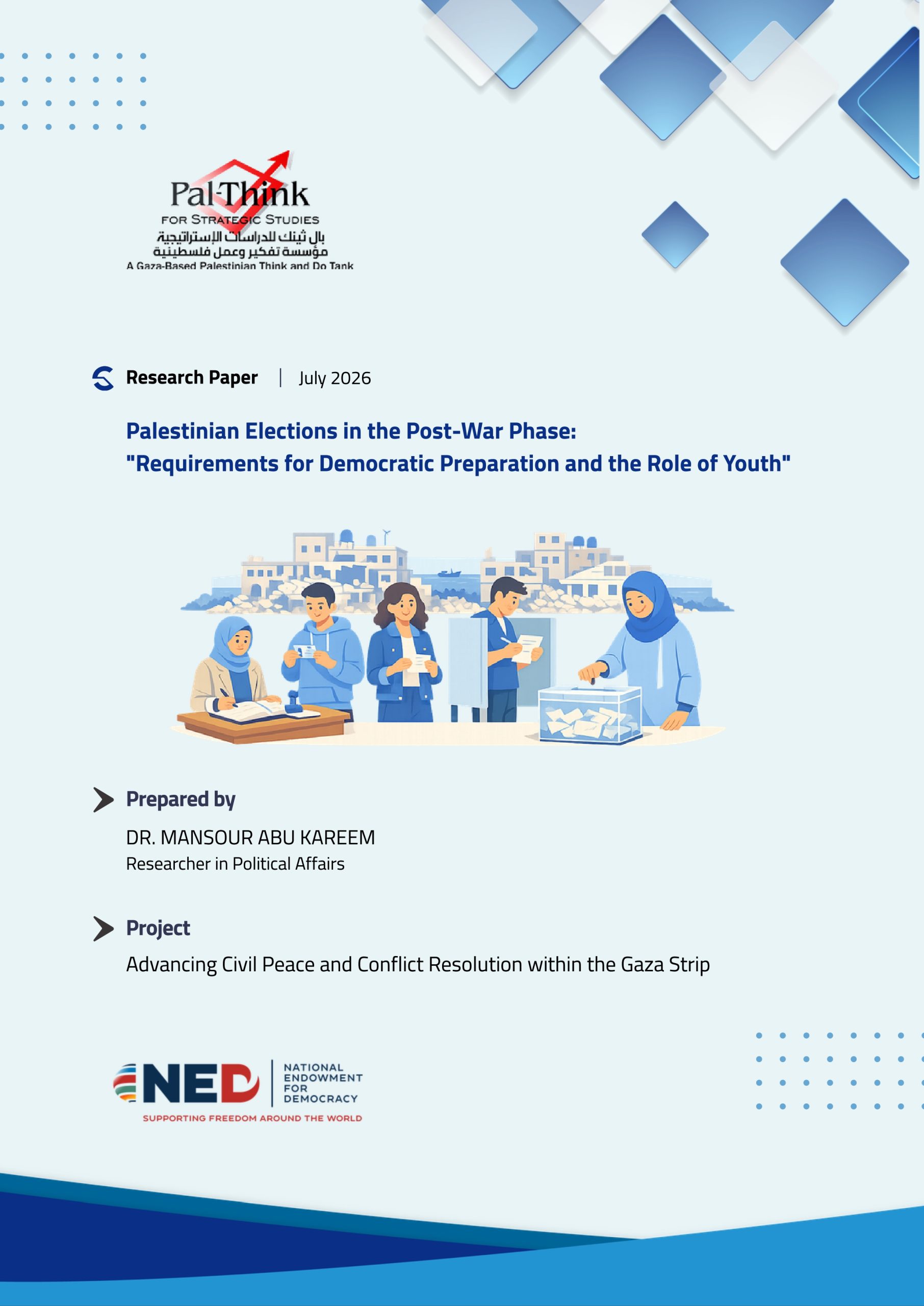
This paper analyzes the prospects for holding Palestinian elections in the current context, amid a complex political, security, and social environment shaped by the ongoing war, its consequences, deep political division, and the absence of national consensus on the transitional phase. It argues that elections cannot be viewed in isolation from a broader political process aimed at rebuilding the Palestinian political system and strengthening its unity and institutions.
The paper presents three possible scenarios: holding comprehensive elections if political consensus is achieved and conditions improve; postponing elections until the requirements of the transitional phase are fulfilled; or conducting partial or local elections in selected areas. It also examines the impact of recent amendments to the Palestinian Electoral Law, particularly those related to the proportional representation system, and their implications for expanding the political representation of women and youth.
The findings indicate that the current logistical and political challenges, particularly in the Gaza Strip, make the organization of comprehensive elections highly complex due to widespread destruction, displacement, and restrictions on movement. The paper recommends prioritizing national consensus and inclusive dialogue, strengthening civil peace, and reviewing the Electoral Law to ensure fair and inclusive political representation.
This paper is published as part of the project “Advancing Civil Peace and Conflict Resolution within the Gaza Strip” implemented by Pal-Think for Strategic Studies in partnership with the National Endowment for Democracy (NED).

Download the paper: click here